The AI rollout everyone forgot: your managers
Aug 23, 2026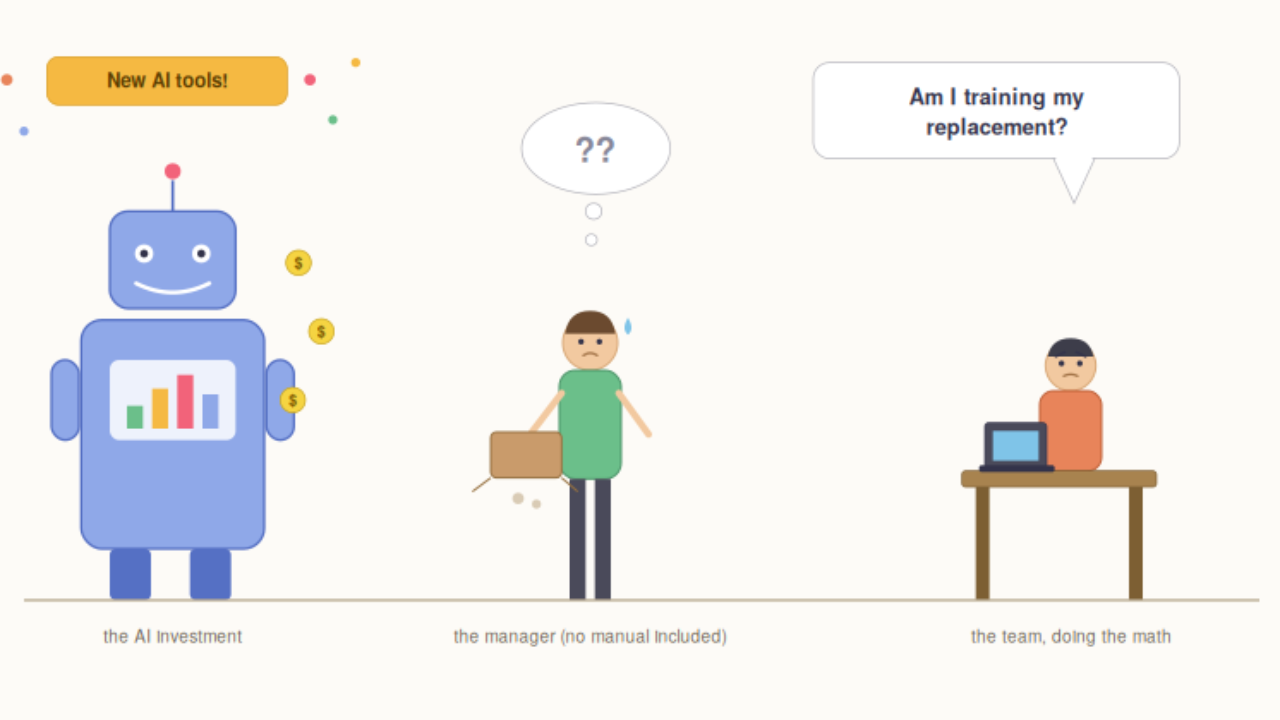
Everyone's buying AI. Who's equipping the managers?
A few weeks ago I was talking with a manager who told me about a one-on-one that stuck with her. One of her strongest performers, someone who never asks for much, paused their conversation halfway through their meeting and asked, "Am I training my replacement?"
She didn't have a good answer. Not because she doesn't care, and not because she isn't smart. She didn't have an answer because nobody had given her one. Her company had rolled out AI tools with real fanfare: town halls, demos, a Teams channel full of prompt tips. What it hadn't done was spend a single hour preparing the people who manage the humans using those tools.
That gap is showing up everywhere right now, and I don't think we're talking about it enough.
The investment is real. It's just aimed at one side of the equation.
I want to be fair here. The companies leaning into AI aren't wrong to do it. The tools are genuinely useful, the pressure to adopt them is real, and standing still isn't a strategy. Most organizations I see are doing what they believe is the responsible thing: buying licenses, running enablement sessions on the tools themselves, setting adoption goals.
But look at where all of that investment lands. It goes to the technology and to the individual contributors using it. Almost none of it goes to first-level leaders, the managers who sit closest to the actual work and the actual people. They get the same tool training as everyone else and then something extra: a team full of questions nobody prepared them to answer.
Is my job safe? Why are we tracking AI usage? If the tool does this part of my role now, what happens to me at review time? Should I even mention that I'm worried, or does that make me look like I'm not on board?
Those aren't tooling questions. Those are leadership conversations. Hard ones.
What happens when managers have to wing it
Here's the part that should worry executives more than adoption dashboards do. When first-level leaders get no guidance, they don't stay silent. They improvise. And every one of them improvises differently.
One manager tells her team, "Don't worry, nobody's losing their job over this." She means well, but she has no idea if it's true, and her team can tell. Another dodges the topic entirely and hopes it goes away. A third overcorrects and tells his people to use AI for everything, which quietly signals that their old way of working is already obsolete. Same company, same tools, same week, and three completely different messages about what the future holds.
Employees compare notes. They always do. And when the messaging is inconsistent, they fill the gaps with the scariest version of the story. Anxiety spreads faster than any rollout plan, and it comes wearing the company's logo, because from where the team sits, "my manager said" and "the company said" are the same thing.
That's the cruel irony. Companies spend all this money to make people more productive, and the unmanaged fear around the tools quietly eats the productivity they paid for.
First-level leaders are the message
There's a truth about organizations that never changes, no matter what technology arrives: for most employees, their direct manager is the company. Not the CEO's all-hands. Not the strategy deck. The person they meet with every week.
Which means the AI story your employees actually hear isn't the one in the announcement. It's the one their manager tells them in a one-on-one when they nervously ask about their future. If that manager is equipped, the story is honest and steady. If not, it's whatever they can piece together on the spot.
We already know this pattern from every major change that came before, from reorgs to remote work. We invest heavily in the change and lightly in the people who have to lead others through it. AI is just doing it at a bigger scale and a faster pace, because this time the change isn't a new org chart. It's a question mark hovering over everyone's job description.
This is fixable, and it isn't expensive
The frustrating thing is how solvable this problem is compared to what companies are already spending. Nobody needs a two-year leadership academy. First-level leaders need a few practical things:
Clear talking points about what the AI investment means for roles, including honest acknowledgment of what's not yet known. "I don't know, but here's what I do know" is a fine answer when a leader is given permission to say it.
Practice with the hard conversation. Not a policy doc. Actual practice responding to "am I training my replacement?" without freezing or overpromising.
A channel to send questions up. When five managers get the same anxious question in the same week, someone above them should hear about it and respond with one consistent answer instead of five improvised ones.
And some acknowledgment that managing a team through this is real work. It's a skill, it takes energy, and it deserves the same investment we're throwing at the software.
The question worth asking
If your company is making a big AI push right now, here's a simple test. Add up what's being spent on tools, licenses, and rollout. Then add up what's being spent preparing first-level leaders to guide their people through it.
If the second number is close to zero, the strategy has a hole in it. Because the tools will do what tools do. Whether people move toward them with confidence or brace against them with fear will be decided in a thousand small conversations between managers and their teams. Those conversations are happening this week, whether anyone prepared for them or not.
The companies that get this right won't just have AI. They'll have people who trust where it's taking them. That second part doesn't come in the license agreement.