The Middle Manager Squeeze Nobody Planned For
Oct 17, 2026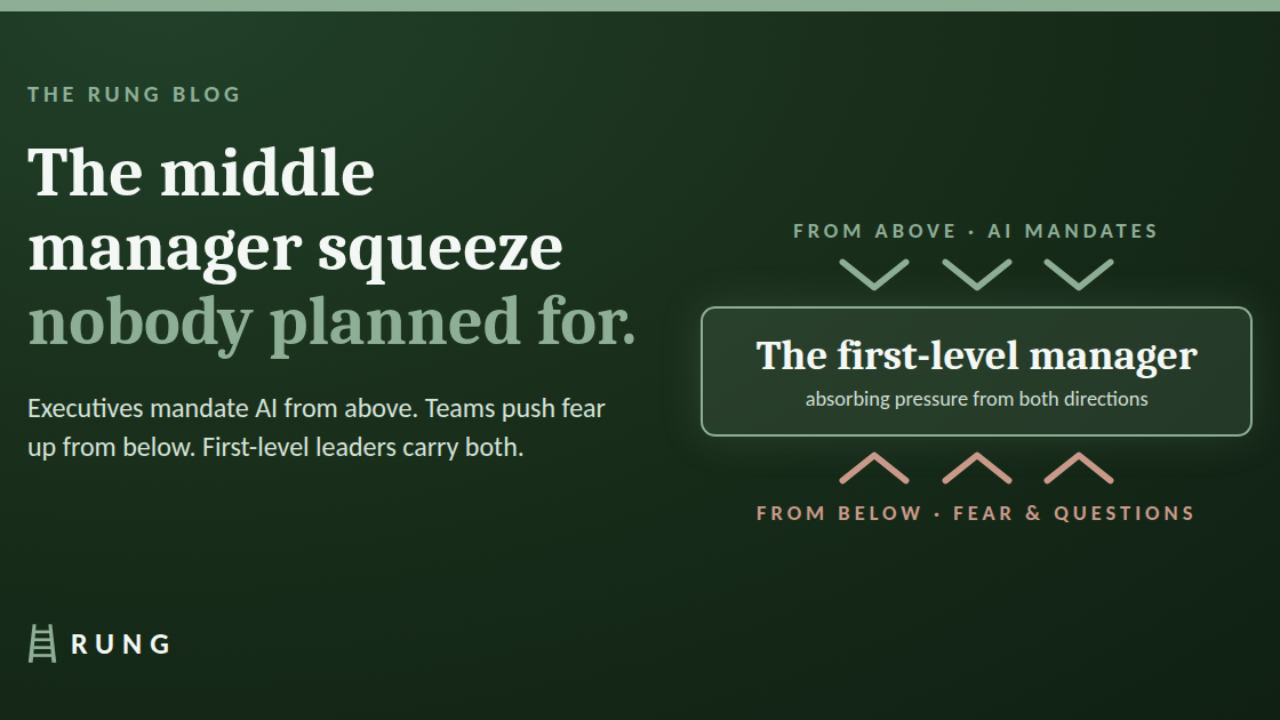
Recently, I wrote about how most new managers step into leadership without a map. This week I want to look at something that's making that gap a lot wider, very quickly.
It's the AI rollout, and more specifically, who's actually carrying it.
The message from above
In most organizations, the AI conversation starts at the top. There's a strategy deck, a new set of tools, and an expectation, sometimes spoken and sometimes not, that teams will be "more productive" by next quarter. The targets arrive with the tools.
What doesn't usually arrive is much detail on how. Which parts of the work should change? What does "using AI well" look like in this team, with these people? What happens to the roles that change the most?
Those questions don't get answered in the strategy deck. They land on someone's desk, and more often than not it's the desk of a first-level manager.
The fear from below
At the same time, something else is coming up from the team.
Some people are excited. Many are anxious, and they ask questions their manager often can't answer. Is this going to replace me? Am I going to be measured against what the tool can do? If I use it and get something wrong, whose fault is that?
Some people stay quiet and simply don't use the tools. Others use them quietly and don't say so. Either way, the uncertainty sits with the team, and the team looks to the person closest to them for reassurance.
That person is their manager.
The squeeze
This is the position many first-level leaders are in right now. They're expected to drive adoption upward and reassure their team downward, often at the same time, and often while learning the tools themselves.
They're translating a strategy they didn't write into daily work they're still figuring out. They're absorbing anxiety they can't fully resolve. And they're doing all of it in a role that, for many of them, is still new.
The research backs up how much rides on them. In a 2025 survey of more than 19,000 US employees, Gallup found that people whose manager strongly supports AI use are 2.1 times more likely to use AI several times a week. They're also 8.8 times more likely to say it helps them do their best work. But in organizations that are already implementing AI, only 28% of employees strongly agree that their manager actively supports its use.
So the manager is the single biggest lever for adoption, and most of them aren't pulling it yet. I don't think that's because they don't care. I think it's because nobody has prepared them for this part of the job.
What nobody planned for
Most AI rollouts plan for the technology: licenses, security, training on the tools. Very few plan for the people in the middle who have to make it work on a Tuesday afternoon, with a nervous team and a deadline.
But this isn't really a technology problem. It's a leadership problem, and it calls on exactly the skills new managers are rarely taught:
- Trust, so people feel safe saying "I don't understand this" or "I'm worried about my job" out loud.
- Honest communication in uncertainty, being able to say "here's what I know, here's what I don't know yet, and here's what happens next," instead of either over-promising or going quiet.
- Managing up, so the gap between the strategy and the reality on the ground actually reaches the people who set the targets.
- Empowerment, letting people experiment, make mistakes and find their own ways to use the tools, rather than handing down a rigid process.
- Consistency, so the team sees the same steady leader whether the rollout is going well or badly.
None of these are new. What's new is how much pressure is on them at once.
If you're the one in the middle
If this sounds like your week, here are three things that help.
- Name the uncertainty with your team. You don't need all the answers. You need to be honest about which ones you have. "I don't know yet how this will change our roles. Here's what I do know, and I'll tell you as soon as I learn more." People cope with uncertainty far better than they cope with silence.
- Bring the reality upward, early. If the targets don't match what your team can actually do, say so before it becomes a problem, not after. Bring what you're seeing and what you'd recommend. Your manager can't fix a gap they don't know about.
- Make it safe to experiment. Give your team permission to try the tools on low-stakes work, share what didn't work, and learn together. You can go first and show your own messy attempts. That does more than any training session.
What organizations can do
If you lead a business that's rolling out AI, look closely at your first-level managers. They're the ones turning your strategy into behavior, one conversation at a time. Give them more than a login and a deadline. Give them the leadership skills to carry their teams through the change.
That's the gap I built Rung to close. The tools will keep changing. The people leading teams through that change need support too.
If you're a first-level leader and want to see where you stand, my free self-assessment takes a few minutes: Self Assessment