
How to delegate as a new manager (without lowering your standards)
Nov 01, 2026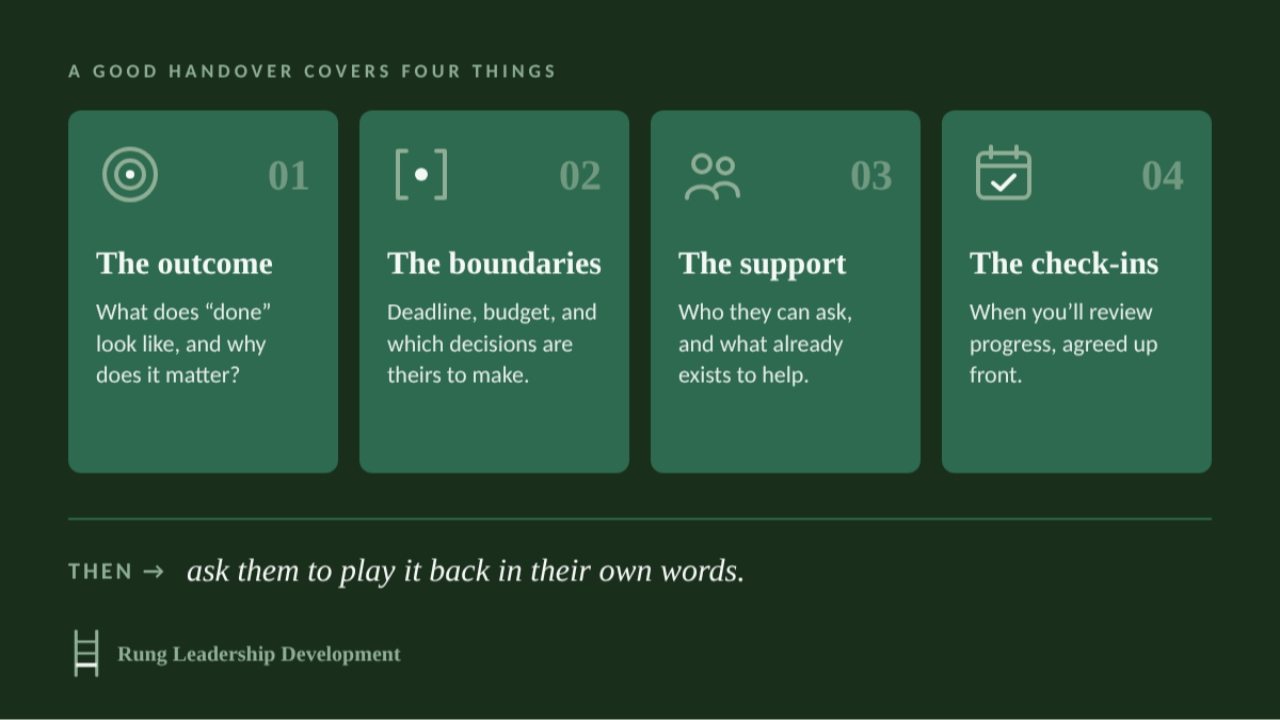
How to delegate as a new manager (without lowering your standards)
A few months into your first management role, you notice something odd. Your team is busy, but you're busier.
You're still doing much of the work you were promoted for. On top of that you now have the meetings, the reviews, the questions and the decisions. Evenings start to disappear. And somewhere in the back of your mind is a nagging thought: wasn't having a team supposed to make this easier?
I was this manager. I answered every question, solved every problem and stepped in whenever things got difficult. I thought that was good leadership. What I'd actually built was a team that couldn't run without me.
Delegation is usually the first thing new managers get wrong. It isn't because they're lazy or controlling. It's because the habits that made them excellent at their old job work against them in the new one.
Why delegation feels so hard at first
If you're struggling to hand work over, you're probably telling yourself at least one of these:
- "It's quicker to do it myself." This week, it probably is. Next month, and the month after, it isn't.
- "I know exactly how good it needs to be." You do. That's the knowledge your team needs from you, and they won't get it if you keep the work.
- "This is the part of the job I enjoy." Giving away work you love can feel like giving away part of who you are.
- "I don't want to look like I'm dumping things on people." A fair worry, and one we'll come back to.
Each of these feels sensible in the moment. Together, they turn you into the bottleneck. Work piles up waiting for you, your team stops growing, and you run out of hours.
What to delegate first
Start with what you actually did last week, not with a theory of what managers should do.
Write down every task, report, meeting and recurring job. Then sort each one into three groups:
- Only I should do this. Performance conversations, hiring decisions, anything confidential or that needs your authority.
- Someone could do this with some help. Work a team member could take on with a clear handover and a couple of check-ins.
- Someone could do this now. Work you're holding on to out of habit.
Group 3 is your quick win. Group 2 is where your team grows.
When you choose, mix it up. If you only hand over the boring admin tasks, your team will notice, and they'll be right. Include at least one piece of work that stretches someone and that they'd be proud to own.
How to hand something over properly
Most delegation goes wrong in the first five minutes. "Can you take care of the client report?" feels clear to you because you know everything you didn't say.
A good handover covers four things:
- The outcome. What does "done" look like, and why does it matter? Describe the result, not every step.
- The boundaries. The deadline, the budget, and which decisions they can make alone and which need you.
- The support. Who they can ask, what examples or templates already exist, and what you'll make time for.
- The check-ins. When you'll look at progress together. Agree on them up front, so you're not hovering and they're not guessing.
Then ask them to play it back in their own words. You'll catch most misunderstandings right there. Follow up with a short written note of what you agreed on, so neither of you has to rely on memory.
In The First Rung Foundation, Module 04 turns this into a one-page delegation brief you can reuse every time you hand something over.
Delegating vs dumping
Your team can tell the difference, even when you can't. Dumping usually looks like this:
- It arrives at the last minute, with no time to do it well.
- It comes with no context about why it matters.
- It's only ever the work you don't want.
- You take it back at the first sign of trouble.
Delegating is the opposite on every count. It's planned, it's explained, it includes work worth doing, and it stays delegated.
The hardest part: not taking it back
The first time someone does a task you used to own, it will be done differently. It might take longer. It might not be how you'd have done it.
Before you step in, ask yourself one question: is this wrong, or just different?
Different is fine. It's often better, because it's someone else's thinking. Wrong means it will miss the outcome you agreed on. That needs a conversation, not a rescue.
When something is going off track, ask before you fix. "How's it going against what we agreed on?" or "What's getting in the way?" Most of the time, the person already knows and just needs room to say it. Every time you quietly take work back, you teach your team that your handovers don't really count.
Your delegation plan for this week
You don't need to hand over half your job by Friday. Start with one task:
- List everything you did last week.
- Pick one recurring task from the "someone could do this with some help" group.
- Choose the team member who would grow most from owning it.
- Hand it over using the four parts: outcome, boundaries, support, check-ins.
- Put the first check-in in both your calendars.
- Leave it with them, even when it's done differently.
Do that every two weeks and in three months your team will be carrying more, growing faster, and bringing you better questions.
Where to go from here
Delegation is one of twelve skills most new managers are never taught. If you'd like to see where you stand on the others, take the free First Rung self-assessment. It takes a few minutes and shows you which skills to build first.
And if you're a new manager, or you manage one, I'm opening a small founding cohort of The First Rung Foundation. Get in touch to find out more.
Alexandra, founder of Rung Leadership Development, has spent 20 years building and leading delivery teams across three continents.