Adoption metrics are the new vanity metrics
Sep 12, 2026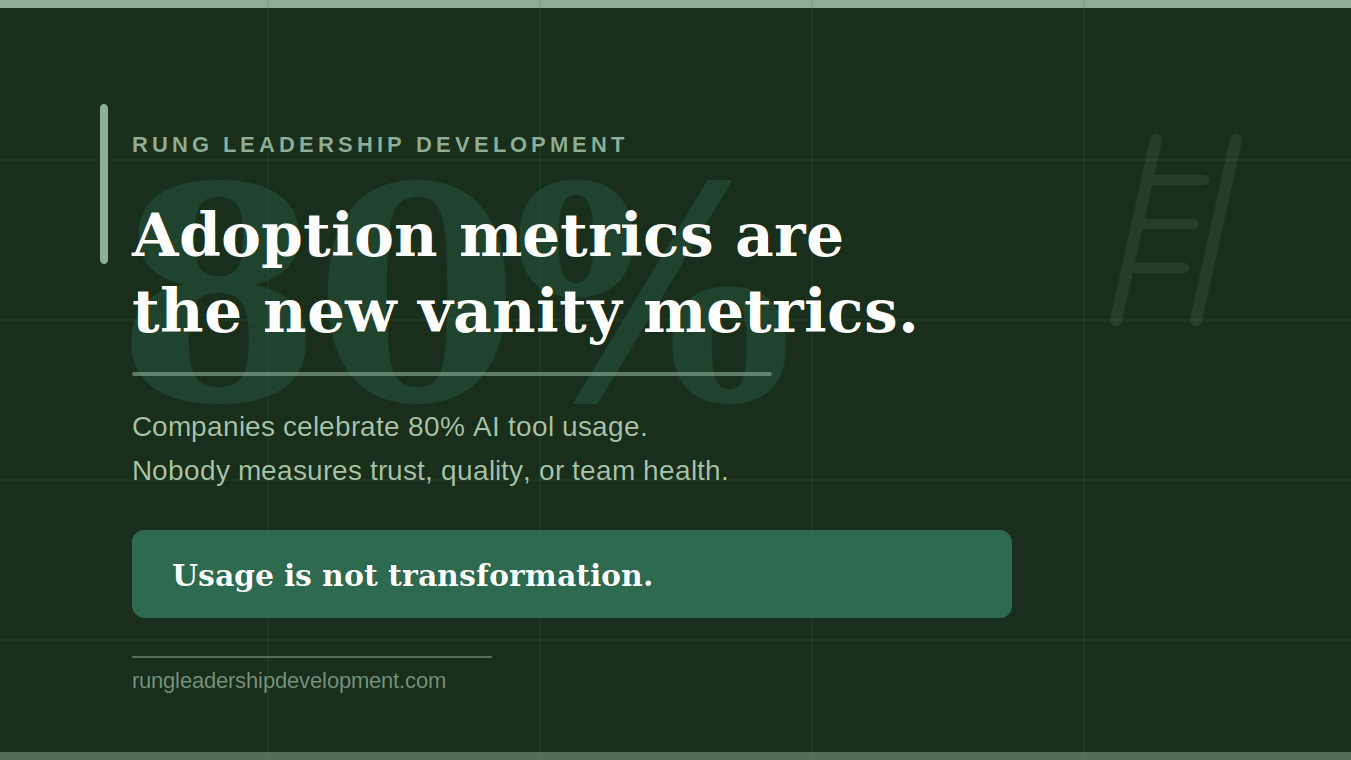
Somewhere in a leadership meeting this quarter, someone presented a slide showing that 80% of their workforce is now using the AI tool they rolled out six months ago.
The room nodded. Someone said "great progress." It went in the board report.
And nobody asked the question that actually matters.
There is a particular kind of metric that makes organizations feel good without telling them anything useful. Usage rates. Adoption percentages. The number of employees who have logged into the platform at least once in the last thirty days.
These numbers are easy to collect. They look impressive in a presentation. They give everyone permission to move on to the next initiative.
They tell you almost nothing about whether anything has changed.
Eighty percent of your workforce using an AI tool means eighty percent of your workforce has opened the tool. It does not mean they trust it. It does not mean they're using it well. It does not mean the quality of their work has improved, that your customers are getting a better experience, or that your managers know how to lead teams through the shift that the tool is supposed to represent.
It means eighty percent of people clicked something.
We have been here before.
The learning management system that had ninety percent completion rates because employees clicked through modules to get the certificate. The employee engagement survey that showed high scores because managers explained what the scores needed to be. The digital transformation initiative that hit every adoption milestone and quietly failed to transform anything.
Measuring whether people are using a thing is the easiest measurement available. Which is exactly why organizations default to it.
The harder question — whether the thing is working — requires different metrics. Metrics that take longer to collect, that are harder to present cleanly, and that sometimes give you answers you don't want.
Is the quality of output actually improving? Are teams making better decisions faster, or are they producing more output of the same or lower quality? Is the pressure to use the tool creating anxiety that's affecting team dynamics in ways nobody is measuring? Are your managers equipped to answer the questions their teams are asking — not about the technology, but about what it means for their roles, their development, and their future?
Those questions don't fit neatly on a slide. That's not a reason to stop asking them.
Here is what I think is actually happening in most AI rollouts right now.
The technology decision gets made at the top. The rollout gets managed in the middle. And the daily reality of what it means to work alongside these tools — to adapt your workflow, to figure out what you can trust and what you can't, to navigate the uncertainty of a job that looks a little different than it did eighteen months ago — lands at the bottom.
On the first-level managers. On the people who were promoted because they were good at the work, and who are now responsible for helping their teams adapt to work that keeps changing.
Most of them were never taught how to lead through change. Most of them are doing it with almost no support, in real time, while also hitting their regular targets and managing the day-to-day of their teams.
And the organization is measuring whether their team clicked the button.
I am not arguing against AI adoption. I'm not arguing against measuring it. Adoption is a precondition for transformation — you can't get value from a tool nobody uses.
But adoption is the beginning of the story. Treating it as the end is how organisations end up with eighty percent usage rates, a satisfied leadership team, and a workforce that is quietly more anxious, more uncertain, and less trusted than it was before the rollout.
Transformation shows up in different numbers. Customer outcomes. Decision quality. Team stability. The confidence of a manager who knows how to hold their team together when the ground is shifting — and who was given the tools to do it.
Usage is not transformation.
And until we start measuring the things that actually matter, we will keep celebrating the things that don't.
Alexandra is the founder of Rung Leadership Development and creator of The First Rung — a twelve-module leadership development program for first-level managers. The First Rung is available now at rungleadershipdevelopment.com